
Health
Uninsured? Here’s where to look for free or low-cost vaccines
By Katherine Langford
Advertisement · Why this ad?
Katherine oversees editorial operations across all six brands. Before joining The Meridan Group, she spent 14 years at the Minneapolis Star Tribune, where she led the metro desk through its digital transformation. She holds a Master's in Journalism from Northwestern's Medill School.
More from Katherine →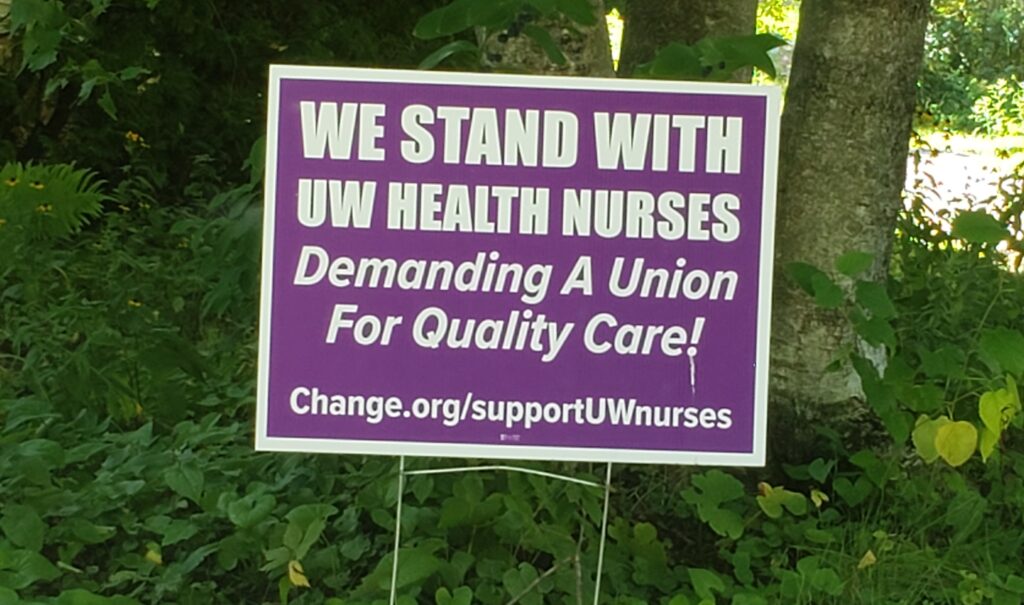
3:45 News Story After a seven-year campaign to reinstate union rights at UW Health hospitals in Madison, organizers are looking to the incoming Democratic governor and majority in the Legislature to help finish the job. Service Employees International Union’s Wisconsin branch mobilized support across the state for winning candidates — from Gov.-elect David Crowley on down to incoming Assembly members who flipped seats on Nov. 3 and put the Democrats in charge of both houses in the Legislature. In an announcement issued Thursday, SEIU Wisconsin members and leaders spelled out their next goal: passing legislation to restore collective bargaining rights at the UW Hospital and Clinics Authority — the corporate parent of UW Health hospitals and clinics. “This moment represents the beginning of a new era,” Colin Gillis, SEIU Wisconsin vice president for nursing and a nurse at UW Health for nine years, told the Wisconsin Examiner. “I’m really excited to have the opportunity, at long last after years of organizing and campaigning — knocking doors, doing phone banking, organizing with my co-workers — to have the opportunity to have a Democratic trifecta that can restore our collective bargaining rights,” Gillis said, “so that we can advocate for our patients and our community and ensure that Wisconsin has the healthcare system it deserves.” The UW Health hospital system’s employees are not classified as state employees. Nevertheless, former Gov. Scott Walker’s 2011 Act 10 — which stripped collective bargaining rights from most public employees in Wisconsin — also eliminated state laws that had guaranteed union rights for UW Hospital & Clinics Authority employees since 1996. SEIU Wisconsin is calling for the new Democratic majority in the Legislature to reintroduce and pass a bill that would “restore full collective bargaining rights for thousands of nurses and over 25,000 total UW Health employees,” the SEIU Wisconsin announcement Thursday said. An email inquiry to UW Health about the SEIU announcement and the prospect of such a law did not get a response Thursday. Nurse cites assurances from Dem leaders Legislation to restore UW Health employees’ union rights was last introduced in February, toward the end of the current legislative session. The bills, AB 999 and SB 965 , were never taken up. The SEIU announcement Thursday identified them as the union’s objective. Gillis said that at campaign events before the Nov. 3 election, he and other SEIU members spoke with the Legislature’s Democratic leaders, Sen. Dianne Hesselbein and state Rep. Greta Neubauer, along with David Crowley, now the governor-elect. “And they gave me and my coworkers, assurance, directly to our faces, verbally, that this would be a top priority,” Gillis said. He said he hasn’t yet heard about a timeline, however. Rep. Lisa Subeck (D-Madison), who has been the lead Assembly author on the previous bills, said Thursday the timeline for action and the exact form it might take still has to be determined. “I’m definitely still committed to restoring collective bargaining rights for our UW Health nursing staff and others,” said Subeck. “I think there is broad support among Democrats for restoring collective bargaining rights broadly.” Subeck, who has been elected Speaker Pro Tempore in the next legislative session, added that it is “a little too soon to say exactly how these bills may be introduced and exactly what that timing would be.” She also said that it “remains to be determined” whether simply repealing Act 10 — as Democratic leaders have said they intend to do — would be sufficient for restoring the UW Health workers’ union rights. “It’s unfortunate that this hasn’t happened already,” Subeck said. “We all know that when the people who care for us, and in this case that’s our nurses at UW, have a voice in their workplace and can have a role in working conditions, it is good for patient care.” Gillis said that he and other union members believe the legislation introduced in February would offer stronger protections for the rights of UW Health employees to union representation than simply repealing Act 10. AB 999/SB 965 include provisions that would allow a majority of employees to win union recognition by signing a petition rather than through an election — the only mechanism for unionizing under current state law, according to the Legislative Reference Bureau analysis of the bill. The measure, if enacted, also would require UW Health to allow unions that represent current employees to provide information at new employees’ orientation sessions, and to allow them to use the work email system to discuss workplace issues, administer union contracts and organize employees. After 2019 launch, union drive escalates After Act 10 ended the UW hospital system’s collective bargaining guarantees, the last contracts expired in 2014. Five years later, in 2019, UW Health nurses announced they were joining SEIU Wisconsin . Initially they sought voluntary talks on working conditions with the hospital system’s management. UW Health rejected their demand. A series of legal memos followed arguing that, despite Act 10, there was a stronger case in existing Wisconsin laws to support union rights for UW Health employees. Encouraged by those arguments, nurses sought union recognition from the hospital system’s management and were rebuffed. On the verge of a threatened three-day strike in September 2022, Gov. Tony Evers brokered a deal between UW Health and nurses affiliated with SEIU Wisconsin. That agreement set in motion a court case that concluded with a unanimous 2025 decision in which the Wisconsin Supreme Court affirmed that because of Act 10, state law does not require the hospital system to recognize or bargain with unions representing its employees. The 2022 agreement also included a provision for voluntary meetings between union representatives and UW Health management. Gillis, who has participated in those meetings, said they have continued since then. “Every other month we sit down for a process, a two-hour meeting called ‘meet and discuss,’” Gillis said. “We have enjoyed a productive and collaborative relationship with our counterparts across the table in that process, but that process is no substitute for negotiation at the bargaining table.” That’s because it doesn’t lead to a formal contract, he said. “Nurses know that a contract is, collective bargaining is, the most powerful tool they have to advocate for their patients and their co-workers and their communities,” Gillis said.
By Katherine Langford

By Katherine Langford
By Katherine Langford

By Marcus Chen